
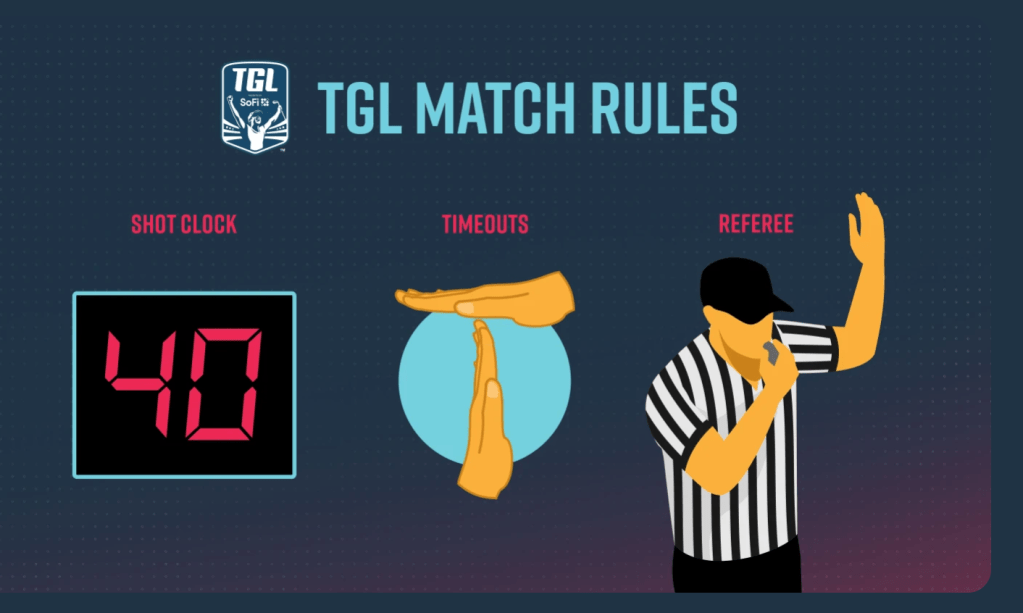
Is this Tiger Wood’s response to LIV or just a creative way to grow the game? Well here’s a story with a twist that might have had some truth a few years back.
There was a golf course unlike any other in a small town nestled amidst rolling hills. It had lush, perfectly manicured fairways, pristine greens, and a reputation for being a sanctuary of tranquillity. But all of that was about to change, thanks to the birth of the Tiger Golf League (TGL).
The TGL was the brainchild of an eccentric billionaire named Bartholomew P. Quibblestein, who had a penchant for turning traditional sports into zany, over-the-top spectacles. He believed that golf, often considered a stuffy and exclusive game, needed a breath of fresh air. And that’s precisely what he intended to provide.
The announcement of the Tiger Golf League came as a shock to the local golfing community. Traditionalists shuddered at the thought of their beloved game being turned into a circus. But curiosity got the best of many, and soon, golfers from around the world were clamoring to be part of the TGL’s inaugural season.
The TGL’s first tournament was set to take place at the Fanciful Fairways Golf Course, and it promised to be a spectacle like no other. As the day of the tournament drew near, the golf course underwent a transformation. Bright neon colors adorned the flags and golf balls. Giant tiger-shaped topiaries lined the fairways, and a live band played boisterous music on the 18th hole. Even the sand traps were not spared and were filled with rainbow-colored sand, which made extracting the golf ball quite an adventure.
The most absurd rule of the TGL was that every golfer had to wear a crazy and elaborate costume. On the first day, the golfers arrived dressed as pirates, astronauts, and even cavemen. Bartholomew himself sported a flamingo costume, complete with oversized wings and an extravagant beak. He felt that if golfers had to look ridiculous, it would take the stuffiness out of the sport. It certainly did.
The first tee-off was scheduled for high noon, but the golfers were not alone. They were accompanied by a motley crew of animals—monkeys, kangaroos, and even llamas—each with a miniature caddy bag. The caddies, trained to fetch golf balls and hand clubs to their respective golfers, added an extra layer of chaos to the event.
As the tournament got underway, it became evident that the TGL was a spectacle to behold. Golfers struggled to putt as monkeys leaped onto the greens, kangaroos bounded across the fairways, and llamas chewed on golf clubs. The audience roared with laughter, unable to contain their amusement at the absurdity of it all.
The Fanciful Fairways Golf Course had also been modified with a series of elaborate obstacles. Giant inflatable windmills obstructed the paths to the greens, and golfers had to putt through rotating tunnels and water slides to reach their targets. One hole required golfers to tee off from a hot air balloon hovering 50 feet above the course. Another involved a cannon that shot golf balls onto the green.
The TGL had its share of quirky rules as well. For example, if a golfer hit a birdie, they were rewarded with a live parrot, which they had to carry on their shoulder for the next hole. The parrots squawked and occasionally stole golf balls, much to the amusement of the crowd. And if a golfer managed to hit a hole-in-one, they were presented with a pie to the face courtesy of a pie-throwing robot.
The gallery surrounding each hole was a spectacle in itself. Spectators wore equally outrageous costumes, and their cheers and jeers added to the carnival-like atmosphere. There was even a designated “heckler’s zone,” where fans could taunt the golfers with humorous insults and creative heckling.
The TGL also introduced the concept of “mulligan cards.” Each golfer was given a set of these cards that they could use at any point during the tournament. A mulligan card allowed the golfer to redo a shot, but at a price—each card had a random and often absurd condition, such as having to putt while blindfolded or using a club made of rubber. The uncertainty of the mulligan cards added an extra layer of excitement and suspense to the competition.
The TGL’s rules were so outrageous that even seasoned golf commentators were left speechless. As the tournament progressed, they found themselves struggling to describe the chaos unfolding on the course. One commentator remarked, “I’ve been covering golf for 30 years, and I’ve never seen anything like this. It’s equal parts absurd and exhilarating!”
In the end, the inaugural TGL tournament produced some unexpected winners. A golfer dressed as a penguin managed to clinch the championship by hitting a hole-in-one on the 18th hole while waddling across a bridge made of giant rubber ducks. The crowd erupted in cheers, and even the stuffed-shirt traditionalists had to admit that they had never seen anything like it.
The success of the TGL’s first tournament was undeniable. It had brought a level of excitement and unpredictability to the sport of golf that had never been seen before. Bartholomew Quibblestein’s vision of a golf league that embraced silliness and absurdity had come to life, and the world couldn’t get enough of it.
The TGL’s popularity grew rapidly, and it soon expanded to include a series of tournaments held in various exotic locations around the world. Each tournament featured its own set of bizarre challenges and obstacles, and golfers eagerly embraced the opportunity to showcase their creativity and sense of humor.
The TGL also had a philanthropic side, with a portion of the proceeds from each tournament going to various charitable causes. The league’s unconventional approach to golf had garnered a new, younger audience, and this demographic was more than happy to support the charitable efforts.
As the TGL continued to thrive, golfing traditionalists begrudgingly accepted that the league’s existence had breathed new life into the sport. Even some of the most esteemed golf clubs began to adopt elements of the TGL’s zany spirit, albeit in a more restrained manner. It became common to see golfers wearing colorful attire and participating in charity events that featured unconventional obstacles and rules.
In the end, the Tiger Golf League had achieved what seemed impossible at first—making golf exciting, unpredictable, and fun. It had turned the sport from a game of precision and formality into a whimsical, entertaining spectacle that captivated audiences around the world. And while many of the golfers may have looked absurd in their outlandish costumes, they had become the new heroes of a sport that had finally learned to embrace its own silliness.
Yours truly,
Socially Out Of Bounds (SOB)


 Socially Out Of Bounds
Leave a comment